So, I had this dream last night. I was whisked away from a comfortable seaside home and was en route to a brooding boarding school on a high, heathery hill with endless curving switchbacks. (I remember, because I was driving.) In the backseat: a brooding, gorgeous, dark-haired boy. Just the kind of boy you’d expect to see in a YA novel where the protagonist doesn’t know whether to hate him or swoon over him. He may have even had hints of a paranormal past. As we drove to the brooding boarding school where plot was likely to happen, I remember him talking to me in this low, intense voice. Can’t remember the words, sorry.
After I woke up, I sat down and pounded out the first chapter of a thrilling new YA paranormal romance. Just kidding. What I really came away with was the feeling that this guy was an absolute douche-bag. All his brooding and inability to express his tormented emotions resulted in him being really annoying. I was driving to the boarding school to get away from him, actually, but he insisted on following me, obsessed with his love for me. I guess it was love. It wasn’t obvious, beneath all the brooding.
Funnily enough, there was a little follow-up scene about the boarding school. The teacher was reading something in French and butchered the pronunciation. I raised my hand to offer a better reading, but Mr. Brooding cut me off, proved his mastery of French, and flashed me a smoldering smile. That was it. Any chance for a fictional romance was off. In dreams, as in real life, I’m revolted by chauvinism.
Now, the moral of this story. I’ve heard many explanations for why we like to read about romances where the girl picks the exciting, brooding guy over the boring, nice guy. Why settle for safe, he’s-my-best-friend love when there’s the optional of unpredictable, even dangerous, passion? Even I am guilty of writing stories where the girl snubs Mr. Next Door for the smexy mysterious stranger. But my dream last night unpleasantly reminded me that mysterious strangers often have a tendency to become nasty. When the smoldering wears off, there’s not going to be any fun walks through the neighborhood or dishes done in companionable silence. Mr. Brooding is too busy with his own weird hang ups.
I know, I know, romance novels are most definitely not real life. We make much better romantic choices in real life. Usually. Though I have known friends who did actually pursue the brooding guy, and now talk about their relationships in uncertain, bittersweet words. Even sadder, other friends have talked about getting together with guys who seemed darkly exciting, only to later escape an abusive relationship. I seriously think there are many YA novels out there today where the obsessive passion and weird manipulative behavior depict nothing more than unhealthy, harmful so-called romances.
It’s rather icky, to say the least. Why, then, can we not have our fictional girls go for the nice guys?
Now, I know it’s common in young adult novels–especially urban fantasy and paranormal–to remove parents from the picture, or at least relegate them to secondary or tertiary roles. I mean, who wants Mom calling your cellphone in the middle of a secret tryst with a fallen angel? Who wants Dad grounding you for battling demons over the weekend? Occasionally, a parent proves their fictional worth by giving the protagonist magic blood, a shameful secret, or some other deep motivation. Mom is slain by the forces of evil, and this provides the protagonist a burning desire for revenge. Or Dad is actually the leader of those forces of evil, which provides the “I am your father!” plot twist we all saw coming. Fathers also have their moment in the limelight when they play the role of Wise Older Man passing on advice to the new hero.
Mothers, however… do they provide more helpful wisdom than nagging? Do they stay in the home, or do they get to adventure alongside the protagonist? Do they play an active role in the plot, or are they a passive victim for the baddies to hold hostage? Prime examples: in Spiderman, Peter Parker’s aunt and uncle. On the wimpiest end of the Mom Meter, we have the angelic dead mother of Oliver Twist, as depicted by George Cruikshank in this maudlin print. When I was a kid, I owned an abridged children’s version of Oliver Twist which had an even sappier print of Oliver’s mother weeping with happiness in the clouds of heaven. The End.
On the nastier end of the Mom Meter, we have a smorgasbord of nagging mothers and even more evil stepmothers. I’ve seen plenty of stories where the protagonist’s emotional scars result from their mother’s horrible treatment or neglect. Look no farther than the original Grimm’s fairy tales and their Disney derivatives. Apparently, the only good mother is a dead mother. If she’s alive, she’s busy meddling maliciously.
Even if the hero’s mother isn’t really dead, she’s often absent. I’m noticing a slight trend in YA fantasy to have Mom alive, but not really existing. She might worry over the phone, but she isn’t often physically there. In Twilight, Bella leaves her mom behind and goes to live with her dad. In Carrie Jones’s Need, Zara’s mother ships her off to Maine to live with her grandmother. Now, Zara’s grandmother is undeniably badass, similar to the badass great-aunt character in Amber Kizer’s Meridian. “Badass” as in tough, smart, sensitive, witty, and wise. It’s allowable to have an older woman fill this role. I’m just not sure I’ve seen any mothers do it.
But wait: we have the undeniably badass heroine of Kill Bill. If you haven’t seen Volume 2 yet, spoilers! Beatrix Kiddo is equally capable of slaying vast numbers of baddies with her katana and playing mommy by tucking in her little girl at night. This isn’t to say that to be a badass mother, you must also be badass in every other respect. That treads into the realm of unrealistic Mary Sue characters. But Kiddo is certainly an example of a fictional mother who isn’t confined to a passive gender role.
Why, I ask, are there no Kiddos of the YA world? I think urban fantasy, in particular, would lend itself it a badass mother character who’s adventuring right alongside the heroine, teaching her how to swing a sword and deal with her paranormal problems. But the YA part of the equation might be what keeps this from happening: a mother this powerful might overshadow her daughter (or son, for that matter). Is that the crux of the problem? We can’t have strong mothers play too big of a role because they steal the limelight? But still, YA fiction doesn’t seem to be accurately representing how, in reality, most mothers play a significant positive role in the lives of their children. Mine certainly did.
Now, of course, I want to know what you think about mothers in YA. What do you think of their current portrayal, and what would you do about it?
So I’ve been thinking and Tweeting about this for awhile. And have come to the conclusion that there are gobs of paranormal YA romances with this general formula: fairly ordinary human girl goes to school in a fairly ordinary, often boring, town. Then, a new student arrives. A smolderingly sexy, mysterious guy who screams “not human!” You know he’s going to be trouble. But delicious, sexy trouble. This has been done very well, in several books.
We have the sexy fallen angel Patch in Becca Fitpatrick’s Hush Hush. We have the sexy werewolf Sam in Maggie Stiefvater’s Shiver. Oh yeah, and there’s the guy who started it all, Edward.
Often, I tend to eat up these books like dark chocolate. But every once and awhile, I step back from my savoring and think, “Hey. Why are all the girls ordinary, and all the guys drop-dead gorgeous and burdened with a secret paranormal past? Can’t there be a book where a smoldering paranormal girl meets an ordinary guy?” Yes, you say, this has been done before. And you’ve repeatedly said this is one of your all-time favorite YA books, Karen.

Exhibit B
Blood and Chocolate by Annette Curtis Klause stars Vivian, a teenage werewolf girl who’s definitely got the bad-ass sexy thing going on. Just take a look at her claws on that cover. And she pursues a human “meat-boy” in a way that gives Edward a run for his money. There is, however, a catch. Vivian’s part of a love triangle with–you guessed it–a smolderingly sexy, hunky werewolf dude, Gabriel. So that somewhat alters the formula. And the ending is unconventional as well, though I won’t spoil it.
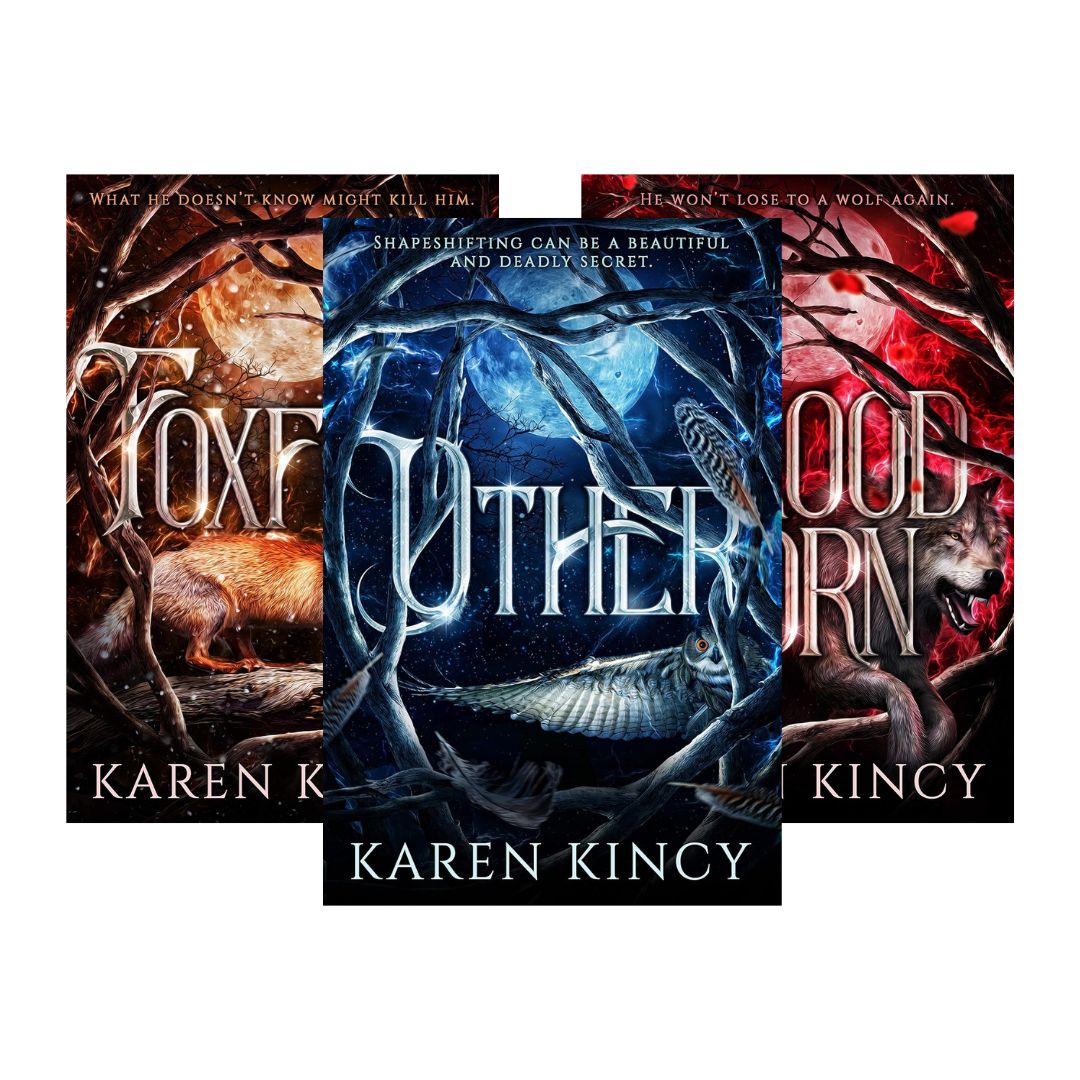
Still, despite Vivian’s sexy werewolfiness, I’m finding a sad lack of paranormal girls meeting ordinary guys. Is it because mostly girls read paranormal YA, and most of these girls like to imagine guys with fangs and golden eyes? Certainly sexy, yes. But I happen to love imagining that I’m the one with the teeth. You’ve undoubtedly noticed that my debut, Other, has a paranormal girl dating a human guy. And Gwen the pooka hasn’t told Zack the human boy who she really is, yet, so we’ve got the mysterious element down. Though I’m not sure Gwen does a lot of smoldering or brooding, and I wouldn’t classify Other as a straight paranormal romance, either.
So my question to you is this: why such a divide in paranormal romance? Would you like to read about a magical girl and an ordinary guy getting together? Or should the sexy brooding and sparkling–er, smoldering–be left to the Edwards of the YA world?